South Carolina could make history by electing first woman US Senator…
Screenshot
South Carolina could make history by electing first woman US Senator…
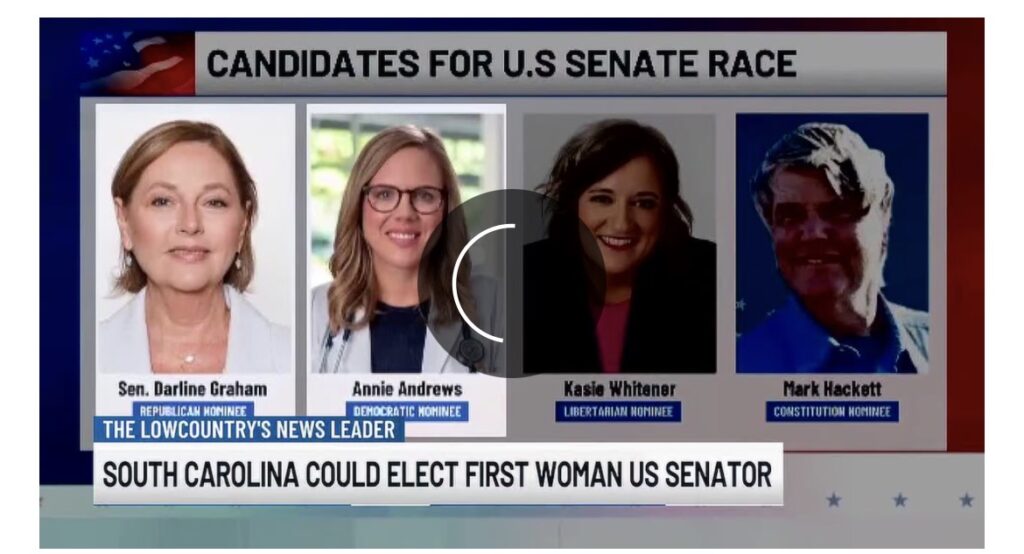
With both mainstream U.S. Senate candidates being women, it’s highly likely our state will elect its first woman senator. And if that happens, the Palmetto State is on track to mark a couple of other milestones as well.
Three women and one man are on the ballot for the U.S. Senate come November. The candidates are Democratic nominee Annie Andrews, Republican nominee Darline Graham, Constitution nominee Mark Hackett, and Libertarian nominee Kasie Whitener.
While Graham is currently serving the remainder of the term of her late brother Lindsey in the Senate, she was not elected to that position.
But the thought of voters electing a woman to that seat has some people very excited.
“Do you understand that for the very first time in South Carolina we elect a woman, we should be dancing in the aisles, everybody, not just women,” Dr. Marguerite Archie-Hudson said.
The Charleston native is a former College of Charleston professor and served in the California State legislature as well.
Her colleague, College of Charleston professor Dr. Lynne Ford, says that typically across the nation, women only get these opportunities after their husband dies. It’s known as the widow effect. In Darline Graham’s case, it was a sibling who passed away.
Ford says Democrat Liz Patterson of the Upstate was the first woman to break that mold in South Carolina, elected to Congress in 1986 in her own right. But she still had to jump through some hoops that her male colleagues did not.
“She told fantastic stories of having to pretend that she was at home tending to her children, playing games after dinner and then she could attend to the state’s business,” Ford said.
Ford has studied women in politics extensively and is the author of the book, ‘Women and Politics: The Pursuit of Equality.’She says historically, South Carolina has not been eager about electing women to higher political levels.
“Well, South Carolina has been slow to admit to a public role for women. South Carolina voted against ratification of the 19th Amendment, giving women the right to vote. And it was not until a symbolic vote in 1969 that South Carolina ratified the 19th Amendment. South Carolina voted against the Equal Rights Amendment. South Carolina just has a very traditional culture. It’s very traditional Southern culture. And so women in public roles have been slow to emerge,” Ford said.